
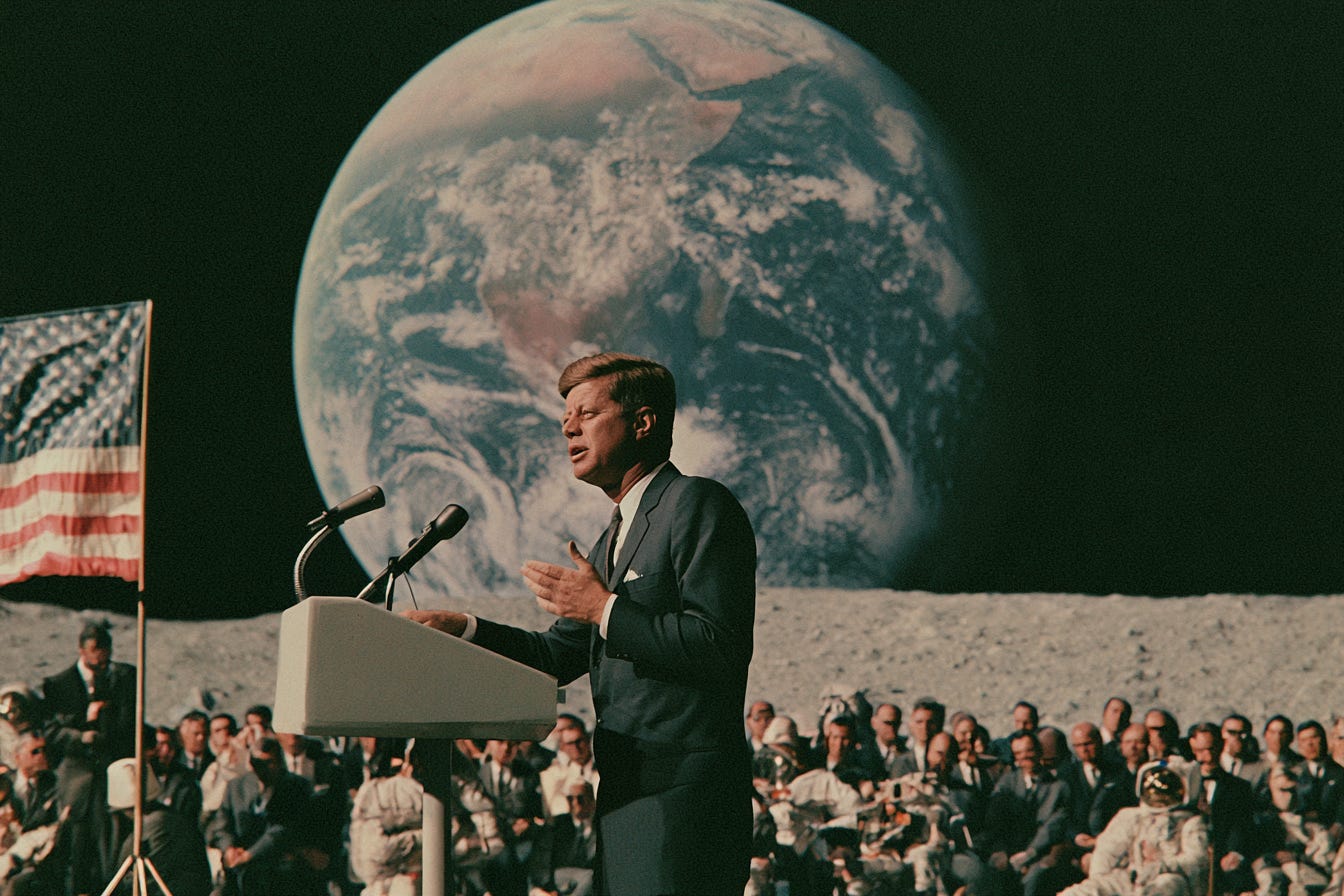
The great quotes of history didn’t just happen to be great, they were engineered that way.
To understand why, you first have to understand how humans remember things.
The human is an information glutton, constantly consuming and looking for more. But we have limited storage, so we maximize the amount we can know by compressing information using patterns. We pattern match by associating new things we want to remember with old things we already know. Even the world’s best memorizers do this, just much better than us.
Great writers know people use patterns for memorization, so they build pattern into their most important lines, making the reader’s job easy.
The study of patterns in language is called rhetoric, and there are fewer patterns than you might think. Classical English Rhetoric, one of the best-known books on the subject, lists just 22.
My two problems with the existing rhetoric literature are
Whoever named the different patterns gave them stupid technical names like Epistrophe and Anaphora. How are people supposed to remember that? Those names are in direct conflict with what the study of rhetoric is all about.
They mainly study text that is 300+ years old. This isn’t inherently bad, we just talked differently back then, so it’s less useful for someone trying to utilize rhetoric today.
So I picked a few of my favorite quotes, teased apart the rhetoric tools that make them great, and renamed the tool.
1. The Parallel
“That’s one small step for man, one giant leap for mankind.”— Neil Armstrong
Armstrong delivered this line at the pinnacle of humanity’s greatest achievement (walking on the moon), so you might say this line has an unfair boost in notoriety.
But also, no one would quote this if he said, “I’m walking on the moon, this is important for us.” In that way, clarity and conciseness are necessary, but not sufficient, for great communication.
Armstrong gives the two parts of the sentence the same frame. Five words on each side, repeating two and a half of the words.
one small step for man
one giant leap for mankind
Repeating the “man” in “mankind” gives the line a pleasing sense of sameness between the literal man and the conceptual mankind.
The line also delivers a strong metaphor to align pro-gress, as in man moving forward, and prah-gress, as in mankind advancing.
We love repetition, we love metaphors, we love progress, we love this quote.
2. The Reverse
“Ask not what your country can do for you—ask what you can do for your country.”
— John F. Kennedy
The reverse is like the parallel but flipped. The same words are repeated on both sides of the sentence, but to point out an error instead of sameness.
your country → you
you → your country
The reverse is helpful for surprising the reader, it works when you’re rejecting something that is generally felt to be true. In this case, people look to the government to provide them things and JFK says, “No, you!”
Charlie Munger often repeated the advice, “Invert, always invert.” (which also uses repetition). That premise is useful when using the reverse.
3. The Arc
“Civilization begins with order, grows with liberty, and dies with chaos.”
— Will and Ariel Durant, The Lessons of History
The arc is perhaps our most familiar pattern.
The beginning, middle, and end
The introduction, body, and conclusion
The birth, life, and death.
The arc follows the rule of three, which is the idea that things presented in groups of three tend to feel more memorable, satisfying, and complete. Three is the smallest number that can create a complete journey. One thing is just a thing, two things is a thing comparison, but three things is a story. And in the quote above, Will and Ariel Durant give us the concise story of all civilizations using 3 words in each of the 3 parts.
4. The Cycle
“Hard times create strong men. Strong men create good times. Good times create weak men. And weak men create hard times.”
— G. Michael Hopf
The cycle is a lot like the arc, except it bends back to the beginning. A good cycle will connect so cleanly that nothing feels unresolved.
Cycles feel familiar because we live them. Day and night, the seasons, the economy, and life all follow cycles. These cycles are just patterns that become more visible when you zoom out.
Hopf combines the cycle pattern with repetition to make this quote memorable. You only need to remember the quote starts with “Hard times,” and logic carries you through the rest, each phrase knocking into the next like a row of dominoes.
5. The Stairs
“I’m a libertarian at the national level, a Republican at the state level, a Democrat at the municipal level, and a socialist at the family level.”— Nassim Nicholas Taleb
Taleb shares the surprising idea that someone can be both a libertarian and a socialist. It is surprising because we don’t normally use political labels to describe how someone runs a family. The surprise makes it memorable, but the structure makes it memorizable.
The structure is like a staircase, as the scale of government descends down, his tolerance for control ascends up. Much like the cycle, you only need to remember that Taleb starts at the top of the stairs to follow the pattern of revealing the rest.
There are many more patterns I could explore, perhaps in a future WIBTAL. But one thing feels clear. How you say something is just as important as what you say. Take away the repetition from these quotes, or add a word that breaks the rhythm, and they become immediately less memorable.