
A statement can be literally false and not dishonest. A statement can also be technically true while creating a false impression. Therefore, intent determines honesty more than accuracy.
That distinction forms the basis of what I call the Four Quadrants of Communication.
4 Quadrants of Communication
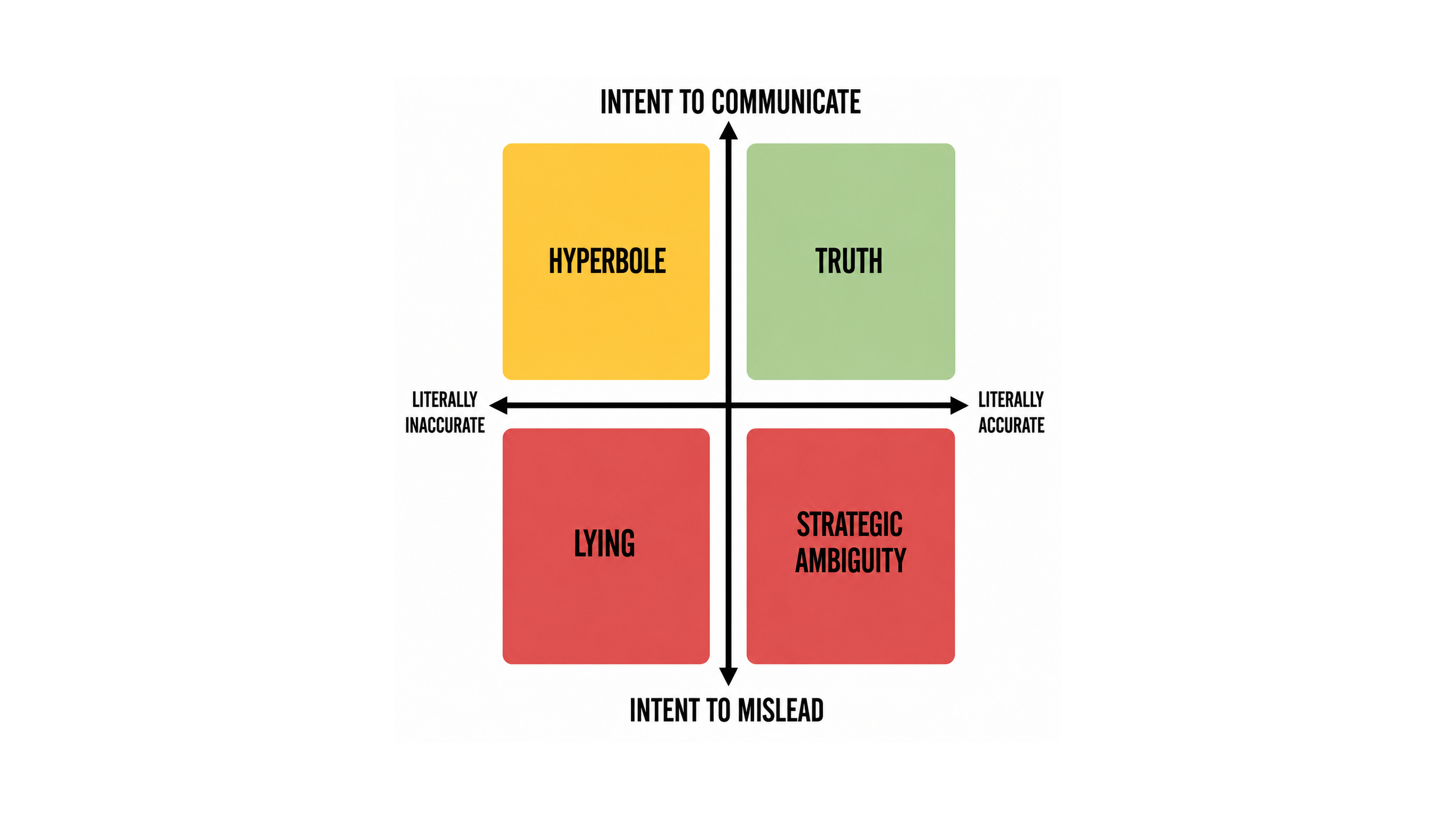
The quadrants classify individual statements, not people. The colors reflect how I feel when I receive each type from someone that I have an ongoing relationship with and therefore expect a reasonable degree of honesty.
They are not universal moral judgments, rather, it’s just a silly little chart.
Hyperbole
Hyperbole is deliberate and obvious exaggeration used for emphasis, emotion, or humor. It is not intended to be understood as fact.
“I’m starving”
“I’ve told you a million times.”
“This bag weighs a ton.”
While these phrases are literally false, their intended meanings are easy to understand. Mostly harmless, but sometimes annoying, so still think it’s best to be literal. Okay
Truth
I like truth, especially when it is unpleasant. The more someone is willing to tell me unpleasant truthful things, the more pleasant I find our relationship. Good
Lying
I hate lies, especially casual ones. A casual lie signals that you are willing to manipulate another person’s perception, even when the stakes are low. Bad
Strategic Ambiguity
Strategic ambiguity is the deliberate use of multiple possible interpretations, allowing the speaker to later deny one of them.
“Per my last email” means, “Apparently, you are an idiot and can not read”
“He’s an interesting guy” means “I don’t like him”
“Does this dress look okay?” means “Please reassure me that I am attractive”
The ambiguity is strategic because it allows the sender to claim a different intention depending on response.
Email sender can claim they were just pointing you in the right direction, even though they metaphorically spit on you
Commenter can claim they never said anything bad about the guy because they used a positive sounding word
Girl can claim to herself that she was just wondering about the dress because directly asking for a compliment devalues it
Strategic ambiguity transfers the risk of communication from the speaker to the listener. The speaker gets to imply something without owning it while the listener has to decide what was really meant.
These statements are not inherently bad, but repeated strategic ambiguity signals a low-trust relationship where the speaker is continually placing the burden of interpretation on the listener. Ideally, a relationship should trend towards less and less ambiguity over time. Bad.
I argue that Strategic Ambiguity (SA) is a positive. Yes you don’t want it to be the only form of communication, but I think all of the communication has it proper place. (Maybe not claiming your relationship to Hockey stars, or maybe?). I think using SA as a way of communicating allows for correction to be done without requiring humility or fault. This type of communication is very helpful in business (which I think is why you readily had those examples).
Context dependent communicators are way better than anyone who just sticks to only a single box. Including lying.